Happy Workplace
Phihong believes exceptional talent drives sustainability. We are dedicated to creating a LOHAS (Lifestyles of Health and Sustainability) workplace that respects human rights, fosters employee happiness, and enhances job satisfaction and belonging.
Human Rights Due Diligence
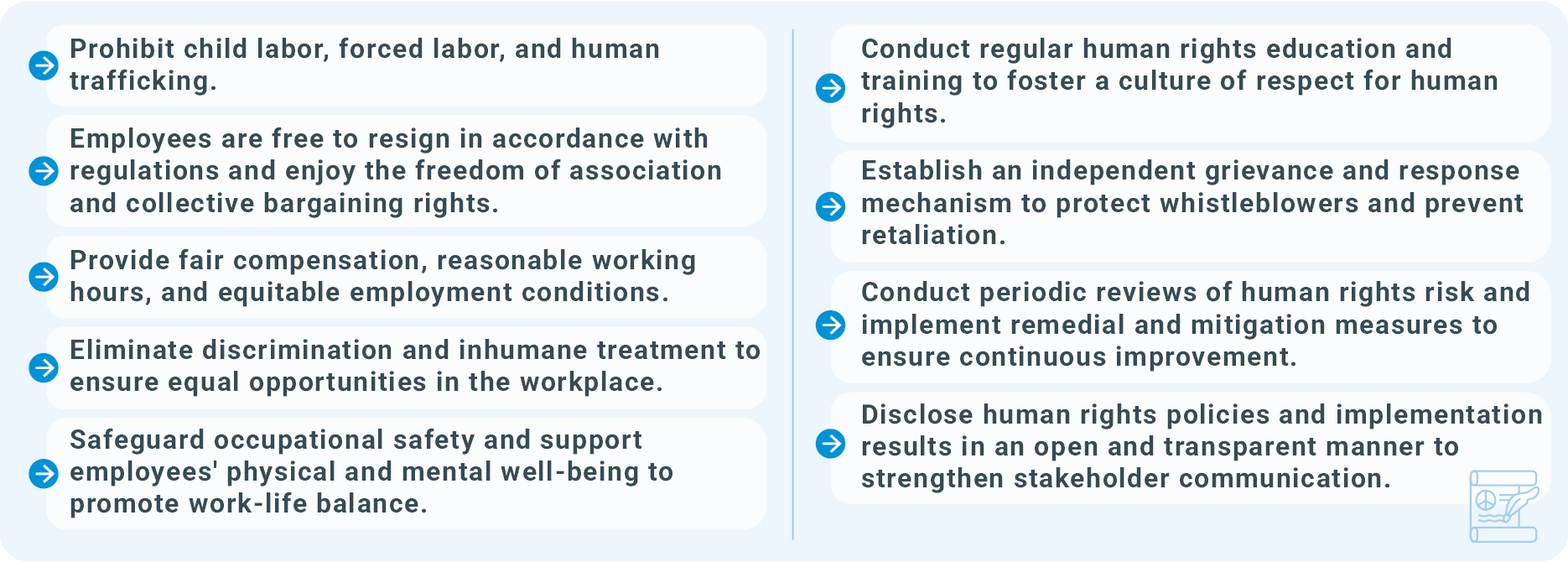
Phihong firmly believes that respecting human rights and creating a dignified work environment are crucial. The Company is committed to following and supporting various international recognized human rights principles and standards, including the UN Universal Declaration of Human Rights, the UN Global Compact, the International Labour Organization ( ILO) Declaration on Fundamental Principles and Rights at Work,the UN Guiding Principles on Business and Human Rights, and the OECD Guidelines for Multinational Enterprises. In alignment with these principles, the Company strictly abides by labor laws at all operational locations to protect the legal rights of employees. The Company also regularly reviews and updates its human rights policy. Guided by the three core principles of “Protect, Respect, and Remedy,” Phihong adopts practices in line with the RBA Code of Conduct. We strictly prohibit any actions that infringe upon human rights, demonstrating a high level of commitment to human rights through concrete actions.
Phihong’s Human Rights Policy applies to all employees within the Phihong Group, covering full-time, part-time, contract-based personnel, and interns. It also extends to domestic and overseas subsidiaries,suppliers, customers, partners, joint ventures, and other entities or legal persons with substantial control. All stakeholders are expected to adhere to consistent standard of human rights, working together to prevent
any form of human rights violation or infringement. Our Commitment

Due Diligence Process
Phihong conducts human rights due diligence in alignment with the RBA Code of Conduct. The objective is to identify and further assess potential risks related to human rights issues, implement appropriate actions and mitigation measures, and ensure ongoing improvements. All of this is aiming to fulfill our firm commitment to respecting and protecting human rights.
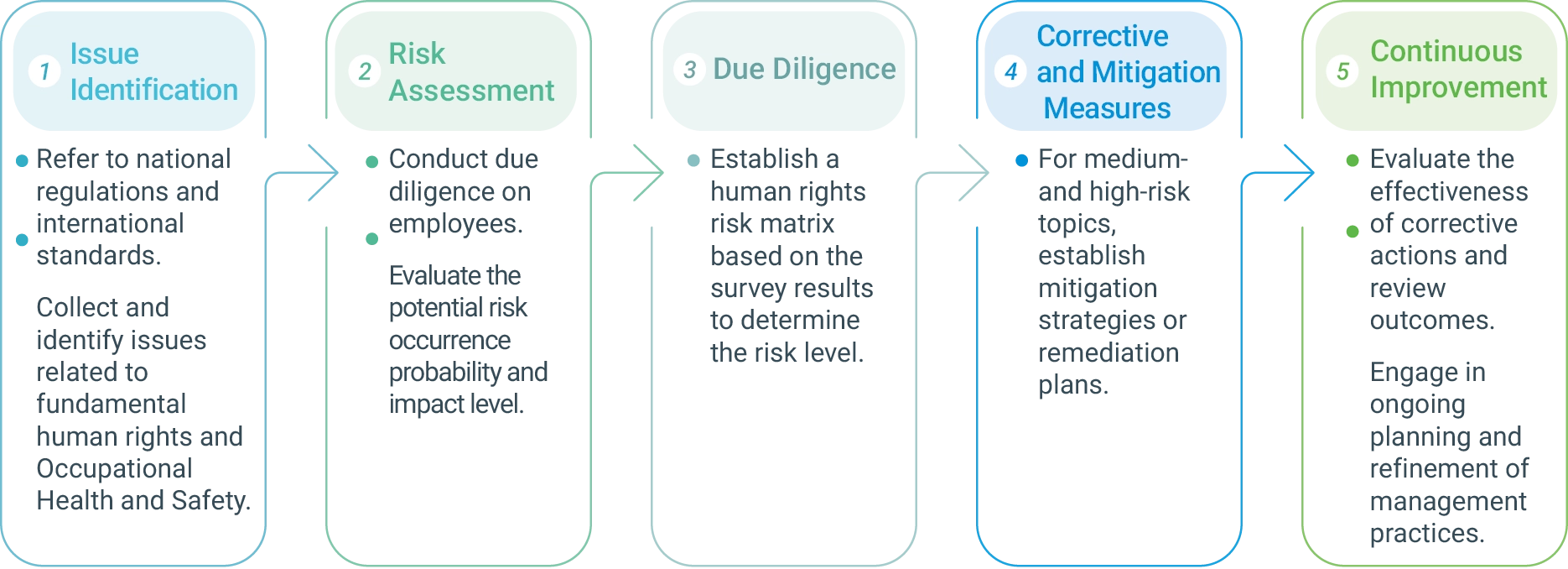
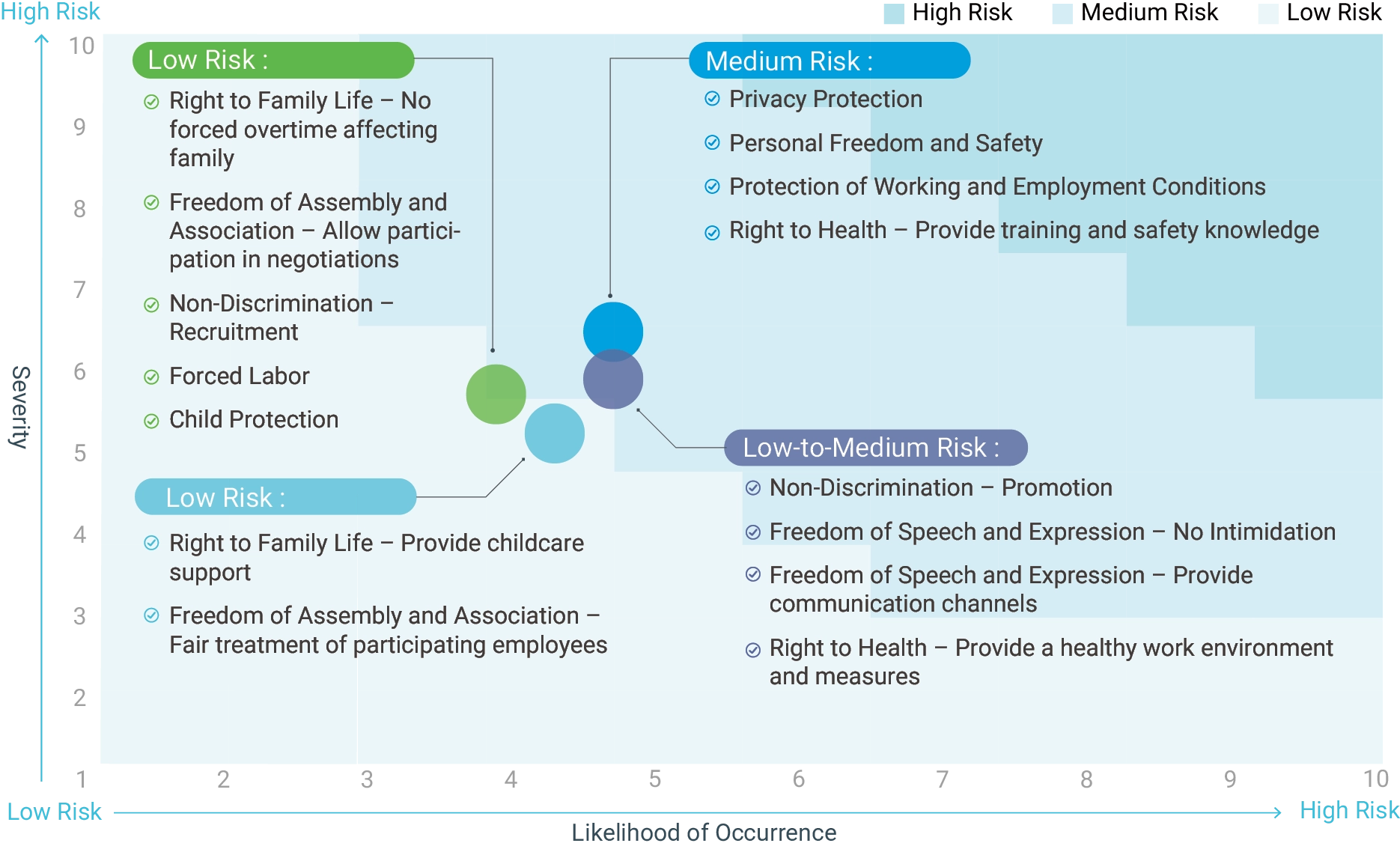
Phihong conducts Human Rights Due Diligence regularly every two years, and in 2024 completed a comprehensive Risk Assessment for operational sites and third-party workers ( such as dispatched or outsourced personnel ). We integrate stakeholders’ opinions through multiple channels and quantify risk classification using a dual-dimensional approach of severity and occurrence probability, establishing a scientific management baseline with risk levels categorized on a scale from 1 to 10. Based on the identification results at various points in the value chain, Phihong systematically assessed the affected groups and actively planned prevention, mitigation, and remediation measures. At the same time, we continuously optimize our human rights management system to ensure corporate governance aligns with international standards,deepening our commitment to sustainable development.
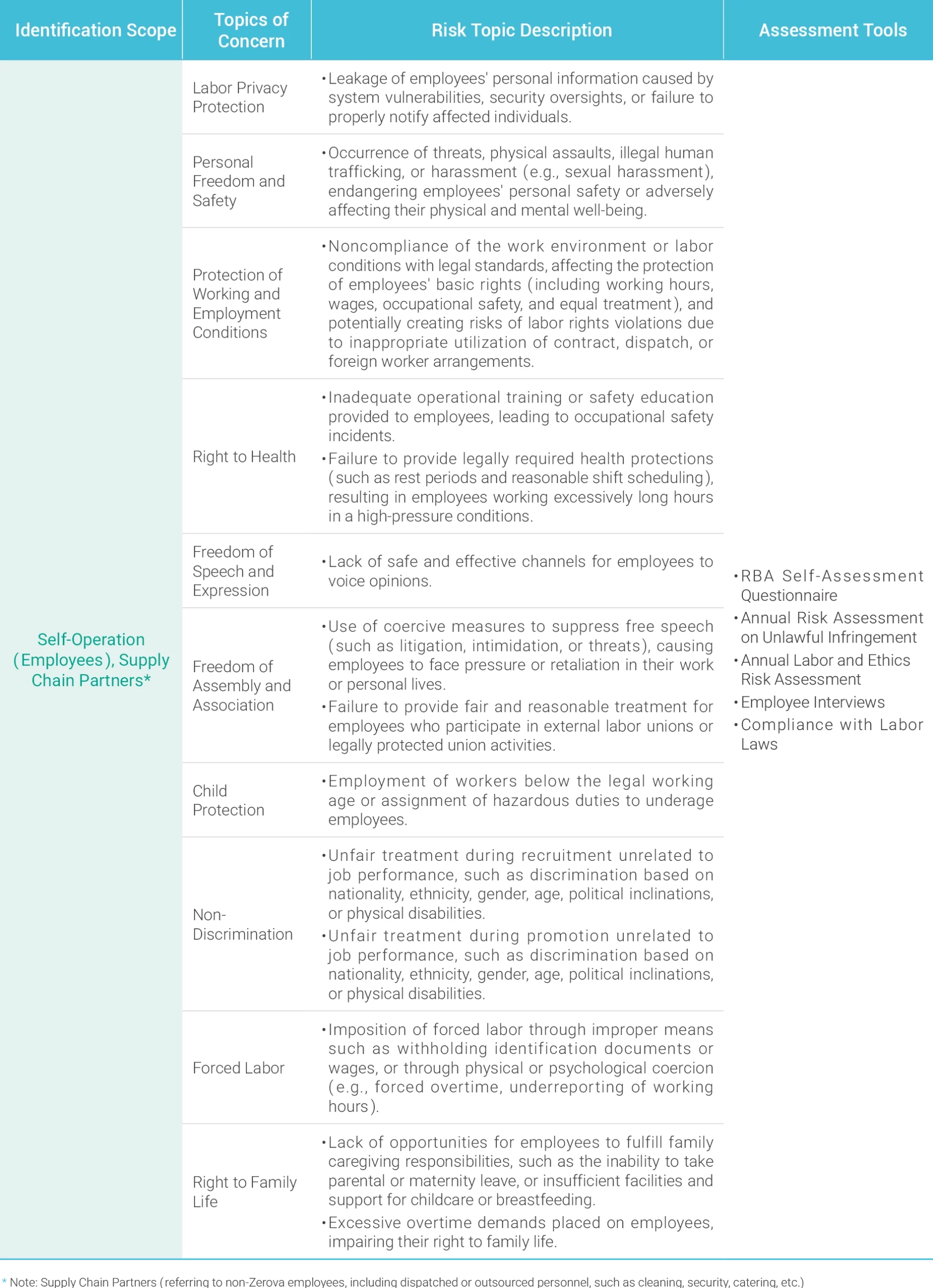
According to the overall survey display, the risk levels for each human rights topic all fall within the low-to-medium risk category. The company established a human rights risk matrix based on the formula: Risk Exposure = Likelihood of Occurrence × Severity of Impact, to identify topics with relatively higher risks. After reviewing the results of the human rights risk assessment, the Company has submitted topics with relatively higher Risk Exposure to the management team for incorporation into daily management and decision-making considerations. In the 2025 year, the Company continued to strengthen relevant control measures, including enhancing internal advocacy and education and training, reviewing the effectiveness of existing systems and grievance channels, and continuously tracking improvement results to further
reduce potential human rights risks and fulfill its commitment to human rights protection.
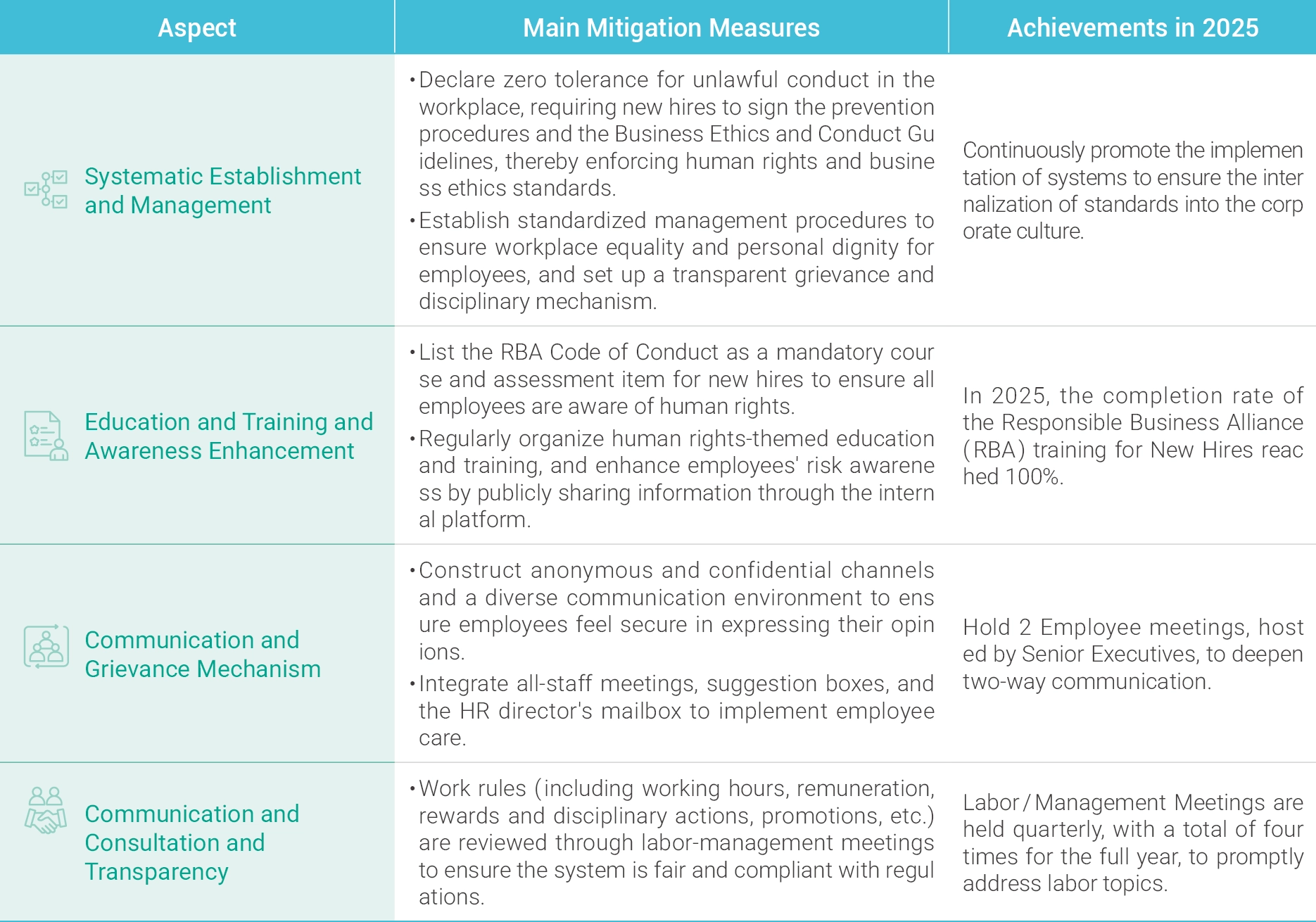
Phihong actively implements human rights due diligence by developing specific actions for potential risks, strengthening prevention and
continuous improvement mechanisms through systematic management and process optimization. Through regular reviews and continuous
improvement, combined with education and training and internal communication, the company enhances employees’ human rights awareness and risk identification capabilities. Based on the identification results, it promotes Mitigation Measures, integrating human rights management into daily operational processes.
Phihong continuously strengthens system implementation and governance efficiency to ensure the management mechanism is consistent
and traceable, demonstrating the company’s maturity and international standard in human rights protection and sustainable governance. In
2025, there were no violations of human rights, instances of child labor or employment discrimination, nor any significant penalties or legal
proceedings related to violations of labor regulations.
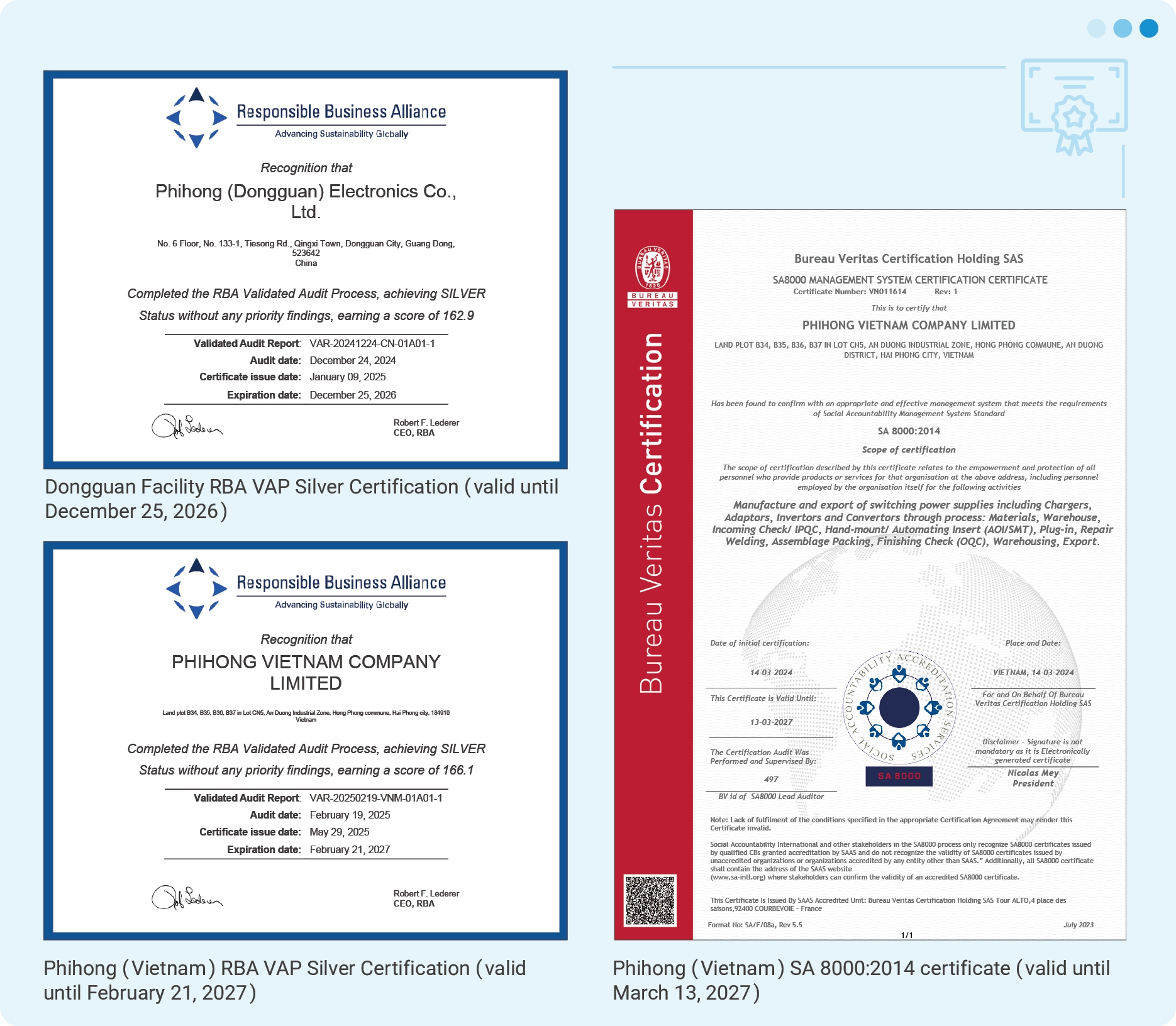
Phihong has deeply embedded the belief in social responsibility and sustainable development, officially joining the Responsible Business Alliance (RBA) as a certified member in 2022. We fully support and implement the RBA Code of Conduct, transforming its vision into a concrete management system to collaboratively build a sustainable value chain with employees, customers, and suppliers.
Through the RBA Validated Assessment Program (VAP), Phihong continuously examines the implementation degree of its internal systems. In 2025, Phihong’s main Production Sites all demonstrated outstanding compliance achievements, specifically implementing the RBA 8.0
standards:
Dongguan Facilities (PHC/PHP): In December 2025, successfully passed the RBA VAP audit, achieving excellent scores of 162.9 and 169.2, and obtained Silver Certification.
Haiphong Facility (PHV): In March 2025, successfully passed the audit and obtained certification.On the foundation of the existing SA8000 Social Responsibility Management System, we have fully integrated the latest RBA 8.0 standards to establish the “Corporate Social Responsibility Management Handbook,” which serves as the core guideline for promoting sustainable transformation.
Phihong is committed to going beyond regulatory standards by actively safeguarding the rights of stakeholders in aspects such as environmental protection, occupational safety, and human rights protection.
System Optimization: Regularly review the legality of human rights policies to ensure that the management mechanism is in sync with international conventions and regulations.
Decision-Driven: Regularly report human rights due diligence results and improvement progress to the management team, incorporating assessment effectiveness into management decisions to achieve continuous improvement.
Phihong is committed to conveying sustainability awareness to supply chain partners,strengthening risk management and organizational resilience to gain high recognition from global customers. We continuously optimize our internal management systems to expand sustainable
business opportunities with high-quality social responsibility performance, working hand in hand with partners to achieve mutual benefits for all stakeholders.