To Stakeholders:
The world is currently in a crucial era of rapid restructuring. Geopolitical risks, supply chain restructuring, and extreme climate are continuously altering the industrial environment, presenting businesses with more severe challenges. Facing a highly uncertain market situation, Phihong firmly believes that “Sustainability is Competitiveness,” and with stable operations and forward-looking planning, has officially launched the “Transformation 2.0” strategy.
Resilience and Transition in Adversity
In 2025, due to geopolitical and tariff factors, the demand in the electric vehicle charging pile market slowed down, resulting in full year revenue of NT$9.796 billion, a decrease of 10.11% compared to the previous year. However, Phihong continues to drive product portfolio optimization and high added-value positioning, not only maintaining strong profitability but also actively entering high-growth areas such as AI server power supplies, low Earth orbit satellites, and high-power Energy systems. We firmly believe that the true value of a corporation lies in its continuous creation of long-term impact amid adversity. Through “Transformation 2.0,” Phihong is transitioning from a leader in traditional power technology to an integrator of energy solutions.
Innovation Technology and Green Growth
Phihong continues to deepen Gallium Nitride (GaN) high-efficiency power technology, promoting high power density and low-carbon design, actively responding to global
energy-saving and carbon reduction demands. In the domains of AI and emerging applications, we are actively positioning in the AI data center and low Earth orbit satellite power supply market. As product verification is gradually completed, related revenue is expected to show significant growth momentum by 2026. The subsidiary, Zerova, continues to drive energy transition with high-power charging equipment and smart energy management systems, gradually building a comprehensive energy value chain.
Sustainable Governance and a Thriving Future
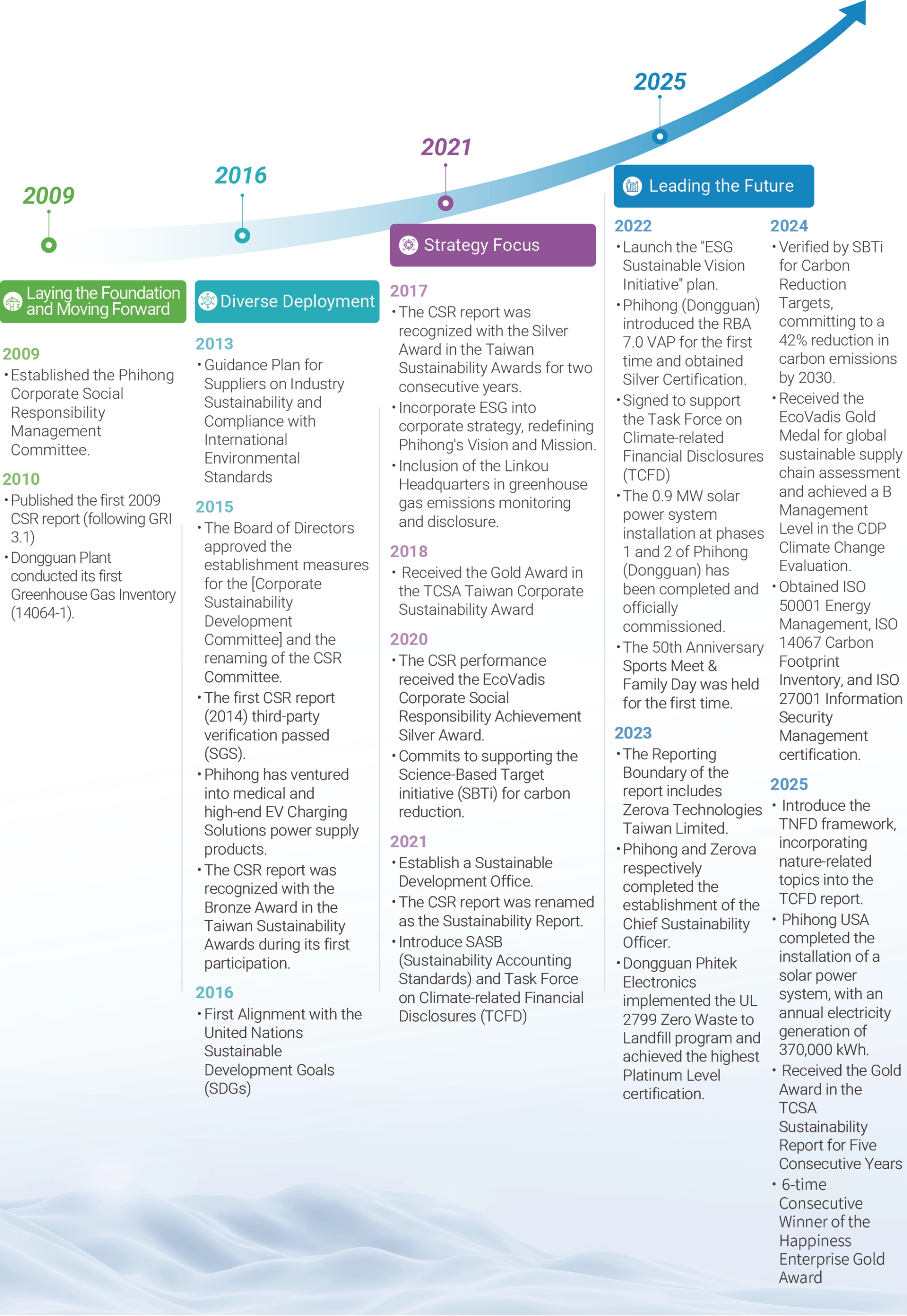
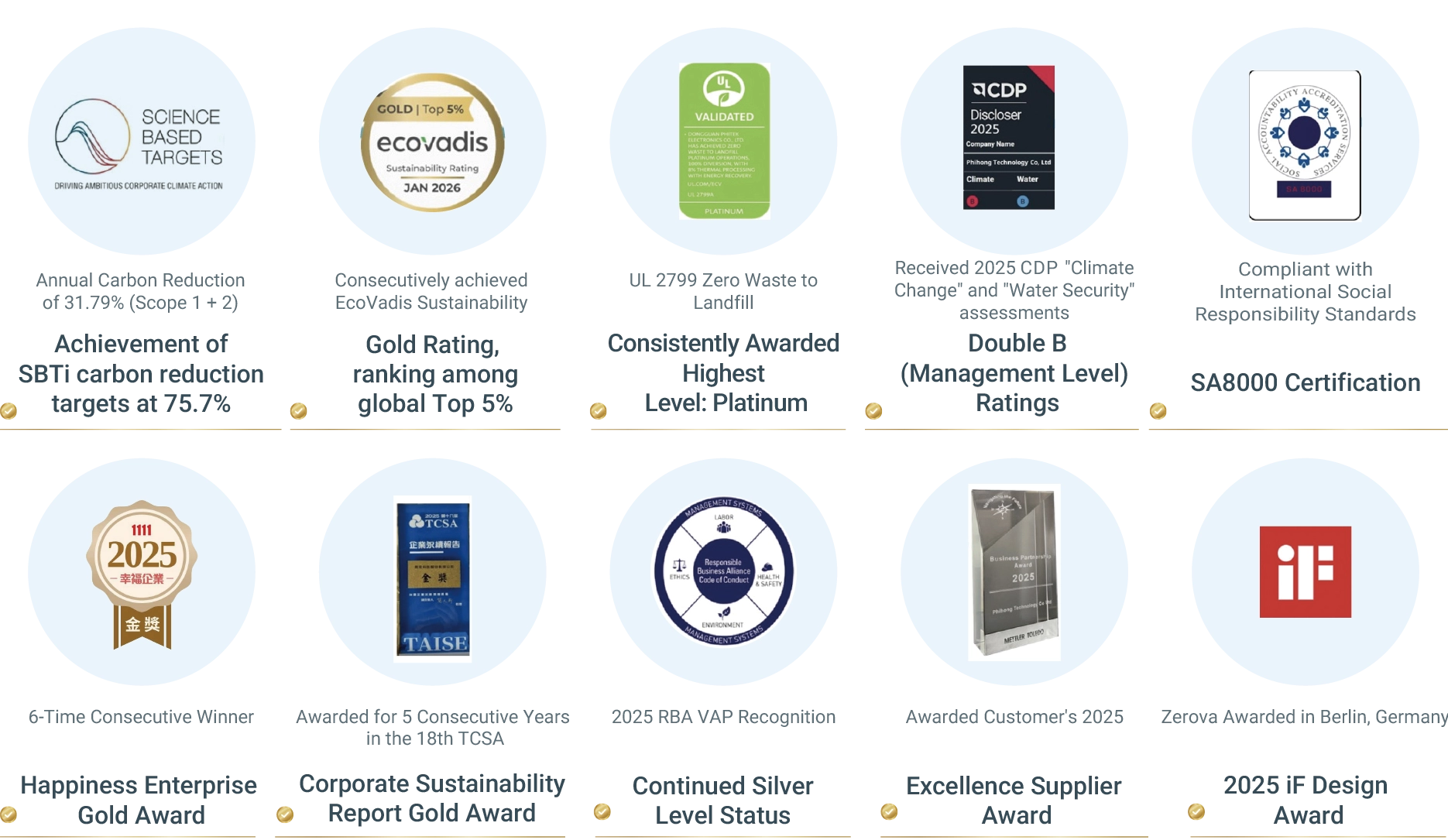
In terms of sustainable governance, Phihong has been verified by SBTi for Carbon Reduction Targets and received a “B level” management rating in both CDP Climate Change and Water Security assessments. Simultaneously, it has adopted the TCFD and TNFD frameworks to strengthen climate and nature-related risk management. In addition, we have continuously received the EcoVadis Gold Award and the RBA VAP Silver Rating, and have been awarded the Happiness Enterprise Gold Award for six consecutive times, demonstrating our long-term commitment to responsible management and career development.
Looking ahead, Phihong will partner with Zerova and global value chain partners to continuously promote low-carbon transformation and sustainable innovation. Through a more resilient business model, we will steadily stride toward an inclusive and sustainable future.
Sustainability is not just a responsibility; it is the ability for a company to define its future competitiveness.
Group General Manager


Facing dramatic global changes in 2025, corporate sustainability is no longer just a responsibility; it pertains to the core capability of “survival and competitiveness.”
The world is simultaneously facing multiple structural challenges: the intensification of climate change, accelerated supply chain restructuring, rapid increase in AI and energy demand, and significantly heightened geopolitical risks. Especially in the Middle East region, the expansion of conflicts not only impacts the energy market and global trade order but also increases the uncertainty for businesses in terms of energy safety and operational resilience. At the same time, the number and intensity of global conflicts reached a record high, displaying that the business operating environment has entered an “era of high volatility.”
In this context, the connotation of sustainable development is rapidly evolving from being primarily focused on “carbon reduction and disclosure” to emphasizing both “resilience, risk management, and value creation.” International trends also display that ESG is evolving towards a more substantive and performance-oriented development, requiring companies to respond to stakeholder expectations with data and achievements.
Phihong deeply understands that only by integrating sustainability into core strategies can a company maintain a competitive edge in a turbulent environment.
Therefore, we continue to drive the three major pillars of sustainable transformation:
I. Climate Action Intensification: From Carbon Reduction to Low-Carbon Competitiveness
Following the international net-zero trend, we have passed verification for science-based carbon reduction targets under the SBTi framework, and systematically
promoted carbon reduction management across Scope 1, 2, and 3. Through high-efficiency power products and energy-saving technologies, we assist customers in
reducing their carbon footprint, turning Climate Action into a market opportunity.
II. Resilient supply chain: From prioritizing efficiency to coexisting with risk
Amid trends of geopolitical shifts and supply chain reorganization, we strengthen supply chain transparency and localization strategies to enhance operational stability, adopting responsible procurement and human rights management mechanisms to ensure the sustainability and resilience of the value chain.
III. Sustainable Governance Upgrade: From Compliance Disclosure to Decision Integration
We have implemented the TCFD and further aligned with the TNFD framework, incorporating climate and nature risks into the decision-making process. This strengthens the governance and risk management capabilities of the Board of Directors, continuously enhances the quality of information disclosures, and responds to
international regulatory trends.
Looking to the future, sustainability will no longer be an added value but the essence of corporate value. Phihong will continue to uphold “technology-driven sustainability
and sustainability creating value” as its core principles. In an uncertain world, we are establishing the foundation for Long-Term stable growth and collaborating with
global stakeholders to stride toward a low-carbon and inclusive future.
From carbon reduction to transformation, sustainability is no longer a choice, but a necessary path for companies to reshape their value.
Chief Sustainability Officer